For Commercial & Industrial Landlords

Your roof is the one part of the building that earns nothing.

A hundred thousand square feet, structurally sound, facing the sun, generating a maintenance schedule and no revenue. We lease it at fixed rent for twenty years or more, and we pay for every study, permit and interconnection application it takes to find out whether yours works.

The Reason Those Roofs Are Empty

It is not the economics. It is the lease.

Drive past any industrial park and count the bare roofs. The arithmetic of rooftop solar has worked for a decade, so the explanation is not economic. It is contractual. Under a triple-net lease the tenant pays the electricity bill, which means the savings from an array accrue to the tenant — while the capital, the roof penetrations, the warranty questions and the twenty-year commitment all belong to the landlord.

No rational owner funds an improvement whose entire benefit is assigned to somebody else. No sensible tenant funds a permanent improvement to a building they may vacate in five years. So the roof stays empty, and both parties are behaving perfectly reasonably. Economists call this the split incentive. Landlords call it Tuesday.

No rational owner funds an improvement whose entire benefit is assigned to somebody else.

The arrangement that breaks the deadlock is older than solar: a landlord leases a surface and collects rent. We pay you for the roof. Your tenant, should they want the power, buys it from us separately at a discount to the utility tariff — or does not, in which case the output goes to the grid or to a community-solar programme and nothing whatever about your tenant's bill changes. Neither of you funds anything. Neither of you is asked to subsidise the other. The split incentive does not need to be solved so much as sidestepped.

What We Build

Three surfaces, one tenant.

I.

Rooftop solar

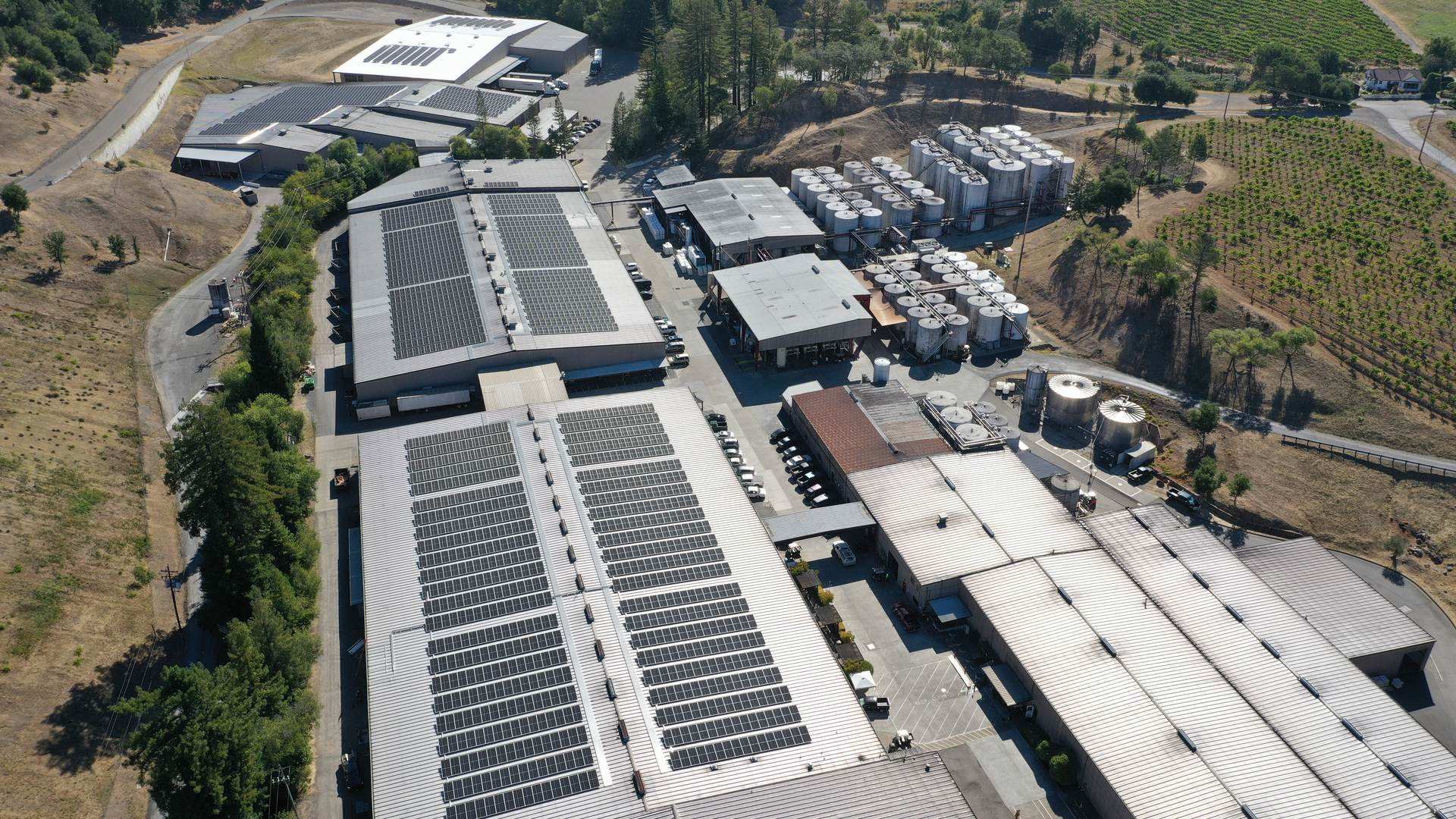
Warehouses, distribution centres, manufacturing plants, big-box and strip retail, office parks, cold storage and self-storage. Racking is ballasted where the roof suits it and flashed to the manufacturer's detail where it does not. Operations beneath continue undisturbed; nothing changes in the building but the electricity bill, and only if your tenant wants it to.

II.

Solar carports & canopies

A parking field is frequently the better asset: unobstructed, free of rooftop units, and structurally yours to build on. The parking remains, the shade is new, and the steel above your tenants' vehicles pays rent for decades while carrying the lighting and the conduit for EV charging later.

III.

Storage

Where the tenant's load is demand-charge heavy — manufacturing, cold storage, anything with large motors — a battery paired with the array shaves the peak and shifts consumption off expensive hours. Sited on a slab beside the building, it occupies a few parking spaces and no roof at all.

What We Look For

A minute with this list will tell you whether to write to us.

None of these is disqualifying on its own. All of them shape the structure, which is why we would rather hear them in the first conversation than discover them in diligence.

Usable roof area
Roughly forty thousand square feet and upward is where a rooftop project begins to carry its own transaction costs. Clear spans, few skylights and a modest population of rooftop units matter more than raw square footage.
Membrane age & structure
A roof with ten or more years of useful life remaining, and the structural capacity for roughly three to five pounds per square foot. Where the membrane is older, see the re-roof question below; it is often the reason to do this now rather than later.
Electrical service & interconnection
Service size, switchgear location and the distance to the utility's point of connection. On a large building this is frequently the binding constraint, not the roof.
Parking & adjacent ground
Parking fields and unused land beside the building regularly carry more capacity than the roof does, and cost less per watt to build.
Lease structure & encumbrances
Who pays the electricity, how long the leases run, whether single-tenant or multi-tenant, and whether a mortgage requires lender consent. We handle the lender and title work; you need the authority to sign.

The Objection We Hear Most

The re-roof question, raised early.

Nobody wants an array bolted to a membrane with four years left in it, and nobody wants to pay to take the panels off and put them back. It is the right objection and we would rather you raised it immediately.

The answer is to sequence the work rather than avoid it. A project can be timed to follow a re-roof you were going to undertake anyway, and in the right circumstances its economics can contribute to the cost of one. Penetrations, where they are needed at all, are flashed to the manufacturer's detail and the warranty is preserved; where ballasted racking suits the roof, there are no penetrations whatsoever. What we will not do is put panels on a roof that cannot carry them for the term, and then describe the resulting problem as yours.

How It Works

Four steps, none of them at your expense.

  1. Send the building

    An address, the approximate roof area and the age of the membrane. A recent utility bill helps if your tenant is willing; it is not required to get an answer.

  2. Desktop feasibility

    Roof geometry, shading, interconnection capacity and the tariff economics of your territory, assessed at our desk and at our cost. Nothing signed, nothing owed.

  3. Lease & diligence

    If the building works on paper we sign a roof lease, then fund the structural assessment, the roof survey, the interconnection application and the permits. Where your lender's consent is required, we prepare it.

  4. Construction and decades of rent

    Built around your tenants' operations, with staging and access agreed in advance. Rent is fixed with scheduled escalations. We own, insure, monitor and maintain the system, and remove it at the end of the term.

The Fine Print, in Plain Language

What a Phæthon roof lease asks of you, and what it does not.

No cost to you
Structural assessment, engineering, legal work, interconnection deposits, permitting. Ours, at every stage.
Your tenants are not obliged
Nobody in your building is required to buy the power. If a tenant wants it, they contract with us directly at a discount to the tariff. If not, the output goes elsewhere and their bill is untouched.
Roof warranty preserved
Work is performed to the membrane manufacturer's specification by contractors it approves, so the warranty survives the installation. We will put that in writing before you ask.
Removal on request
The lease provides for relocation or removal of the array where a re-roof or a redevelopment requires it, on terms agreed at signing rather than negotiated in a crisis.
Your counsel welcome
We draft in plain English and expect your lawyer to read it. A lease that cannot survive a careful reading was never meant to be understood, and you should ask why.

Start Here

Send us the building. We will tell you what the roof is worth to us.

Submit a building